
Deck Composition's Influence on Blackjack Betting Thresholds
Blackjack players track the mix of high and low cards left in the shoe because that mix directly changes the odds and shapes when bets should rise or fall. Researchers have long documented how removing certain cards alters expected returns, which leads experts to adjust betting thresholds based on remaining composition rather than fixed amounts. Data from gaming labs shows that a deck rich in tens and aces boosts player edge while a surplus of small cards tilts advantage back to the house.
Understanding Deck Composition Changes
Each card dealt shifts the ratio of high-value cards to low-value ones, and those shifts matter most when multiple decks remain in play. Observers note that early in a shoe the composition stays close to the starting mix, yet as hands progress the balance moves and creates windows where positive or negative counts appear. Studies from university math departments confirm that penetration depth, the percentage of cards dealt before a shuffle, amplifies these composition effects because deeper cuts expose more of the altered ratios to the player.
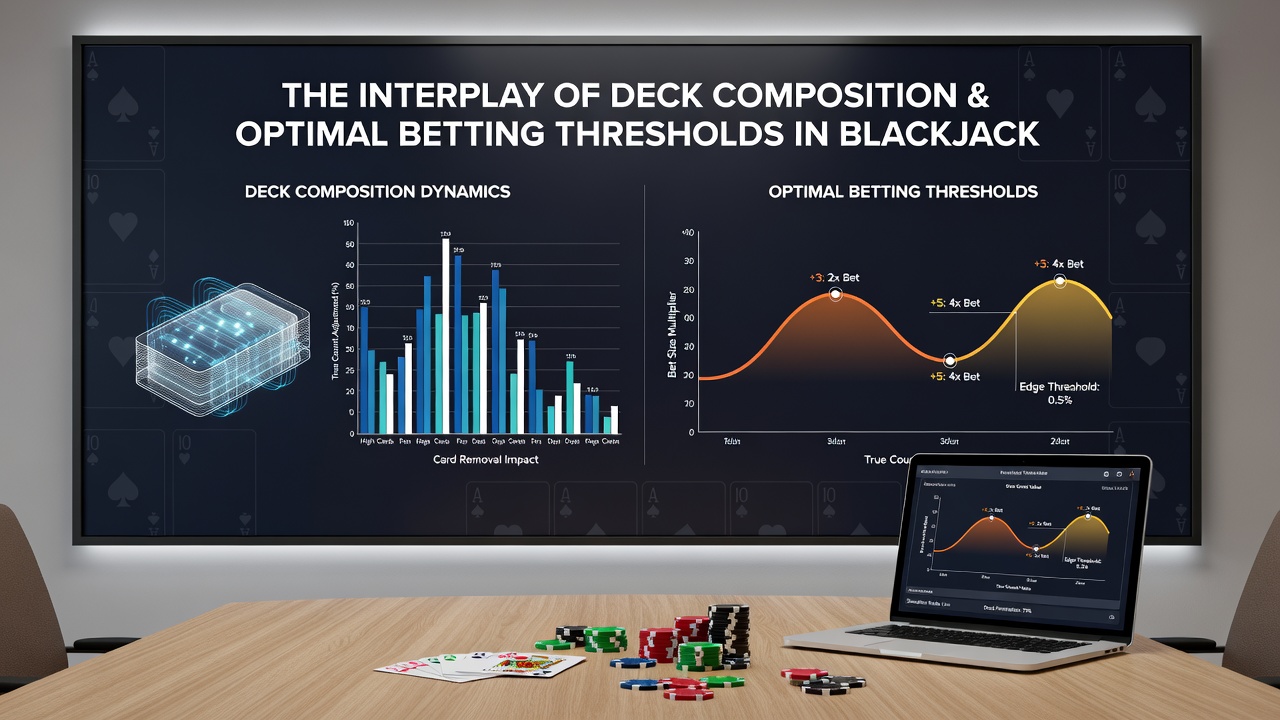
Card counting systems convert composition data into running counts that players convert to true counts by dividing by remaining decks. The true count then feeds directly into betting decisions, telling participants at which thresholds they should increase wagers to capture favorable situations. Figures from industry reports indicate that optimal ramps often begin when the true count reaches +2 or higher, though exact levels vary with rules and number of decks in use.
Linking Composition to Betting Thresholds
Optimal betting thresholds emerge when the remaining cards produce a player advantage that exceeds the house edge under neutral conditions. Analysts calculate these thresholds by simulating millions of hands with varying compositions, then mapping bet sizes to each true count level so risk of ruin stays controlled while return grows. One study revealed that a 1-to-12 spread works well in six-deck games with 75 percent penetration, whereas tighter spreads become necessary when rules limit doubling or splitting options.
What's interesting is how side counts for aces or specific ranks refine these thresholds further because standard counts treat all high cards equally even though aces carry extra value for blackjacks and soft hands. Those who've modeled full composition effects report that incorporating ace adjustments can lift overall return by several tenths of a percent when betting ramps already account for the primary count.
Practical Factors That Shape Threshold Choices
Table rules, deck number, and shuffle frequency all interact with composition to set practical betting lines. Casinos in Nevada often use continuous shuffle machines that reset composition constantly, which removes the long-term edge that thresholds rely upon, whereas single-deck or double-deck games without continuous shufflers allow composition to evolve more dramatically. According to data compiled by gaming research groups, players adjust thresholds downward in games with frequent reshuffles to avoid over-betting during short favorable stretches.
Bankroll size and session length also influence where thresholds sit because larger reserves support wider spreads while smaller ones demand conservative entry points. Simulation results show that a player with 500 units can safely bet at a +1 true count, yet someone with only 100 units may wait until +3 before increasing the wager. Heat from surveillance teams adds another layer, since rapid bet changes tied to obvious count jumps can draw attention even when the underlying math remains sound.
Modern Tools and Ongoing Adjustments
Software programs now calculate composition-based thresholds in real time, feeding live data from shoe readers or manual counts into algorithms that output recommended bet sizes. These tools incorporate current rulesets and penetration estimates so users receive updated lines rather than static charts. In August 2026 several North American properties introduced new multi-deck configurations that slightly altered baseline composition effects, prompting analysts to recalibrate the exact true-count levels where betting ramps begin.
External verification of these models appears in academic papers hosted by institutions such as the University of Nevada, Las Vegas International Gaming Institute, which publishes periodic updates on rule variations and their impact on player returns. Additional benchmarks come from reports issued by the Australian Gambling Research Centre, whose cross-regional comparisons highlight how different regulatory environments affect optimal threshold design.
Conclusion
Deck composition remains the core variable that determines when blackjack betting thresholds activate, and accurate tracking of that composition allows players to align wagers with shifting probabilities. Continued refinement of counting methods, simulation techniques, and real-time tools keeps these thresholds precise even as game conditions evolve across different jurisdictions and rule sets.