
Paytable Designs and Return Percentages Across Wild Card Video Poker Options
Video poker variants that incorporate wild cards rely heavily on paytable configurations to establish return percentages, and these setups determine how each hand combination pays out relative to the wager placed. Observers note that small adjustments in payout values for specific hands can shift overall return rates by several percentage points, while the presence of wild cards adds layers of complexity because they substitute for other cards in multiple ways.
Researchers who examine gaming data have found that full-pay versions of games like Deuces Wild often deliver returns near 100.76 percent when players follow optimal strategy, whereas short-pay tables for the same variant drop below 95 percent. The differences arise because paytables list exact credits awarded for each winning combination, and wild cards expand the frequency of those combinations without changing the base deck structure.
Core Mechanics of Wild Card Paytables
Wild card games such as Deuces Wild or Joker Poker assign wild status to specific ranks, which alters hand rankings and payout eligibility. A paytable lists returns for royal flush, straight flush, four of a kind, full house, flush, straight, three of a kind, two pair, and one pair or high pair, yet the wild elements mean players achieve these hands more often than in standard video poker. Data indicates that when a paytable reduces the payout for four deuces or five of a kind, the overall return percentage declines noticeably because those hands occur with measurable frequency under optimal play.
Paytable rows typically show credits returned for one through five coins wagered, and the fifth coin often unlocks an increased royal flush payout that boosts long-term returns. Analysts reviewing machine data across multiple jurisdictions report that this bonus structure accounts for several percentage points in total return when players consistently bet the maximum.
Impact of Specific Configuration Changes
Adjustments to individual hand payouts produce measurable effects on calculated returns. For instance, lowering the return for a full house from 3 coins to 2 coins in a Deuces Wild paytable reduces the overall percentage by approximately 1.5 to 2.5 points, according to simulation studies conducted by gaming laboratories. Similarly, increasing the payout for a flush while decreasing straight payouts creates a different balance because wild cards enable straights and flushes at rates that standard decks do not match.
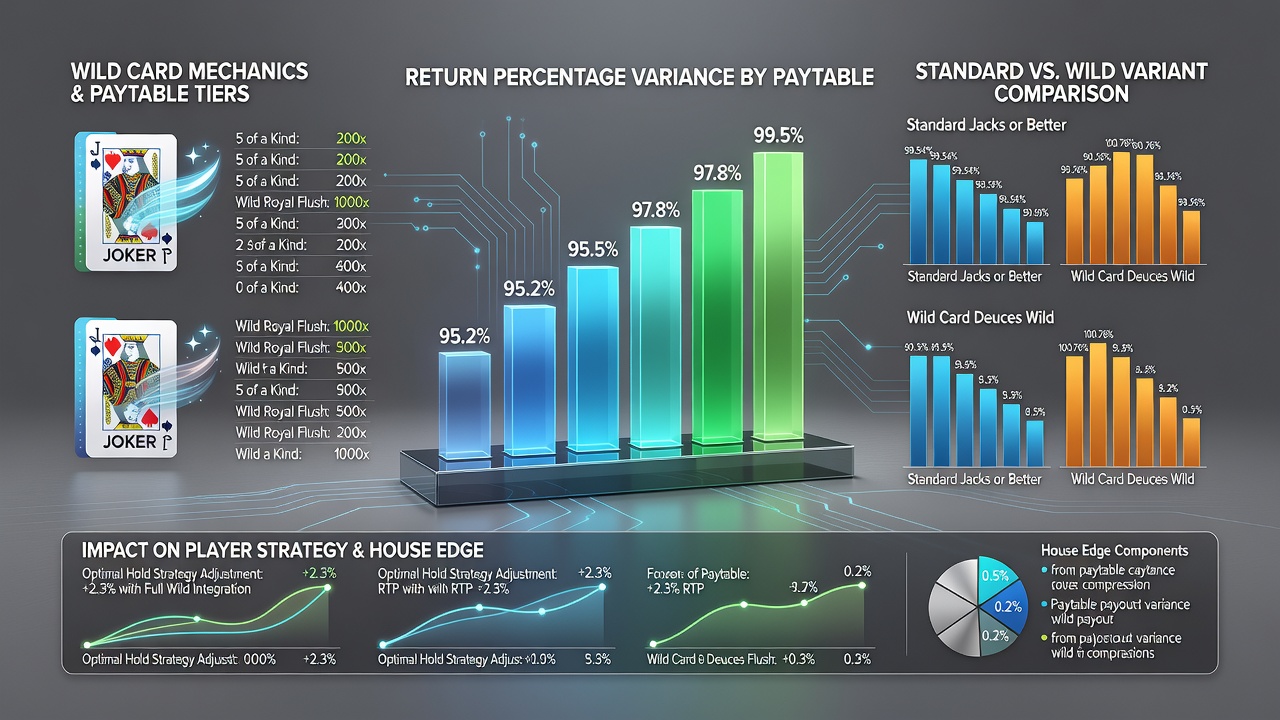
Those who have modeled these games observe that wild card frequency interacts directly with paytable values. In Joker Poker variants, where one joker acts as wild, paytables that award 1000 coins for a royal flush with five coins bet maintain higher returns than those capped at 800 coins. The difference compounds over thousands of hands because royal flushes remain rare yet contribute disproportionately to long-term percentages.
Regional Data and Recent Reports
Figures from the Nevada Gaming Control Board show that licensed video poker machines with wild card features display return percentages between 94 and 100.5 percent depending on the exact paytable offered. Machines placed on casino floors in September 2026 continue to reflect these ranges, with operators selecting configurations that align with player volume and regulatory requirements. A separate analysis published by the University of Nevada, Reno gaming research group confirms that paytable variations account for nearly all differences in theoretical return across otherwise identical wild card titles.
Industry reports from the Australian gambling authorities further illustrate how paytable settings influence outcomes. In jurisdictions where wild card video poker appears in licensed venues, regulators require clear disclosure of return percentages calculated from each paytable. These disclosures reveal that even minor reductions in three-of-a-kind payouts can shift returns below 96 percent when wild cards are present.
Strategy Considerations Tied to Paytable Structure
Optimal play strategies adjust according to the specific paytable in use. Players who switch between variants must recalculate hold decisions because wild cards change the value of certain discards. For example, holding a single wild card becomes more advantageous under paytables that reward four of a kind heavily, while discarding it may prove better when straight and flush payouts receive higher weighting.
Simulation software used by training programs demonstrates these shifts through repeated trials. Results consistently show that adherence to the correct strategy for a given paytable preserves the maximum theoretical return, whereas using a generic strategy across different tables reduces achievable percentages by 1 to 3 points on average.
Conclusion
Paytable configurations directly determine return percentages in wild card video poker by assigning precise values to each hand outcome. The placement of wild cards interacts with those values to produce the final theoretical return, and data collected across multiple regulatory environments confirms the scale of these effects. Operators select specific tables to meet business objectives while players who identify favorable configurations maintain higher long-term returns when applying appropriate strategy adjustments.